





 Review by Violet CLM
- Posted:
- 12 Aug 2006, 01:52 (edited 12 Aug 06, 01:58)
- For: Menace to Wonders
- Level rating: 7.2
I’m not sure why I downloaded this. But I’m reviewing it because it’s just too awe-inspiring to leave unreviewed.
“Menace to Wonders” is a story about Devan trying to take over a galaxy by “charming” the inhabitants. What this means is, if you fight an enemy that isn’t a turtle, it isn’t actually evil, it’s only charmed to be evil. You’re still supposed to kill them, but now you have the optional added bonus of feeling guilty about it. Especially because I think it tells you to cure them at some point. Well, they’re not charmed anymore, right? There are also a few species that resist being charmed into evil, including parrots, sharks, moths, and women.
…yes, women. I’ll get back to that.
The level pack opens with an old cliche which I had totally forgotten about because I thought nobody used it anymore: a nearly-empty Carrotus Day level with a few text signs and an exit. I think it represents the fact that you leave Carrotus to go on these adventures. That doesn’t change the fact that it’s really stupid. If I go out shopping for donuts, I never expect to see a sign right outside my door reading “Story: There is a lack of donuts in your household.” I suppose I should take this on faith as big signs reading “EXIT” are kind of improbable too, but I have a thing against text on sign tiles which would really never actually appear on a sign. So the intro level sucks.
After that, we get into the heart of the pack, these being the Wonders. See, the way the pack works is each main level is a Wonder of the Galaxy, or something like that, each with a different theme – fire, water, heart, space, plutonium, radium, tumbleweed – and at the start of each level, a sign announces the name of the wonder, the creator of the tileset (this is known as breaking the fourth wall), the theme of the wonder, and the inhabitants. For the first level, Vapor Caves of Randomwordgenerator, the inhabitants are Vapor Souls (Pacman Ghosts) and Lava Monsters (Devils). It seems odd that you need to charm devil things with giant green pitchforks and that they’re not evil already, but maybe that’s just racial stereotyping. Onto the Vapor Caves!
…or, let me take that back, onto the Vapor, because while there is steam all over the level, I counted, and there is only one cave. I have no explanation for this. It makes no sense at all. Almost the entire level takes place on small floating platforms against a background of red sky, often jumping from one platform to another over a pit of lava or something. It is about as uncavelike a level design as you can get. Caves would have probably looked better, too, as with so few walls, there is very little eyecandy in this level. Again, it’s mostly just tiny floating platforms, which the tileset (Raging Inferno) is admittedly very good at providing.
Here I will take the time to quote the level description. “there’s no ‘die when you fall’ holes”. This is very true. Instead, there are ‘get hurt over and over until you finally die’ holes. They’re really annoying and tedious, especially the time when Gus places a pit underneath some stomp scenery blocks, so it looks like you’re supposed to go that way, but then you die slowly. Instakill, come back…!
The next wonder is called Fruit Gardens of Vita, and it doesn’t make incredibly good use of the Fruity Landscapes tileset. The thing is, Fruity Landscapes has a very repetitive wall texture. Fruit Gardens of Vita has big walls with no attempt at decoration. There are fortunately some giant fruit, either serving as useless ornamentation on long horizontal stretches of ground (one of the author’s favorite features of level design) or as floating platforms (another), and amazingly sometimes the giant fruit have smaller copies of themselves on top. Giant floating purple grape platforms have grapes on them to eat. It’s kind of cute. It’s kind of predictable. I’ll lean towards cute on this one.
Like Vapor Skyscape, Fruit Gardens of Vita features stomp blocks, platforms, little background or foreground eyecandy, and generally uninspired level design. It does appear to make more attempt to have secrets than its predecessor, though, which is nice. Here I found a blaster powerup which was my constant friend throughout the rest of the pack as I shot enemies who posed me no threat at all due to usually not even having methods of attack. I might as well say now that the enemy placement in this pack isn’t very good. They often kind of feel like afterthoughts added into race levels. Pacman Ghosts, like Sparks, work well for sneaking up behind you, but they are totally useless if placed right in front of your line of fire.
The next level uses Winterland Wonder and is called Winterland of Alimi. It has ice block buildings which are kind of neat, except, you know, Chandie did it better. Oh well. This level is probably better than the last two as it’s actually kind of interesting with variety in scenery and whatnot, has (random) lighting effects, and even features a puzzle. Unfortunately it follows an unfortunate trend, that being having the explanation on a sign after you’ve already encountered the puzzle, so by the time you have an idea what you’re supposed to do the puzzle is ruined and there’s no way to start it over. Still, this level is better than the others.
Why is everything suddenly cooler when placed in a high-tech situation like outer space? Hi-Tech Base of Roibi, using Top Secret ]I[, is so much more interesting than the previous levels that it almost seems like a cool level. Here are all the ideas of the pack. There’s still standard stuff like platforms over deadly pits, and climbing up (or down) staircases while shooting various harmless walking enemies, but there’s also a sucker tube pit, bridges of collapsing scenery (with the letter F on them… huh?), “robot” things that either hurt or help you, secrets, slippery slopes, and a decent
background. If this level were longer and with some better sprite/foreground layer eyecandy, it wouldn’t be too bad.
Waterworld of Tluba is very confusing because the non-turtle enemies are crabs and the inhabitants are supposedly fish. I think that means there used to be fish but Gus forgot to fix the sign. Anyway, it’s a very pretty level, because it uses a very pretty tileset. It could use the tileset a little better, but it’s not bad. The design is also somewhat interesting, with shark rides, grottos, castles, and a puzzle which isn’t actually all that bad except for the fact that all the challenge comes from figuring out what you’re supposed to do without messing it up. Not really all that memorable overall, though.
The(!!!) Natural Park of Simi also uses a nice-looking tileset, Swamps, although I’m somewhat jaded to it due to overuse. The thing is, by this point in the pack the level design seems to have improved enough that instead of being laughably bad they’re just average and not particularly worth writing about. There’s flat stuff, platforms, ramps, and a “puzzle” where you try to figure out which warp to take, which tends to be my least favorite variety of puzzle. It’s a pity, because the next level is Efreet Palace of Alibuda, a truly unusual level which is the real reason I chose to review this, um, non-masterpiece.
Efreet Palace is the level containing the most storylike elements, as the level is largely under the control of a mysterious creature known as an Efreet who also prevents the charming of his pet women.
Pet women.
“Inhabitants; Efreet, Women, Parrots, Lizards.”
They sit around in various places about the level and speak in really bad old english.
One hugs and kisses you very sweetly because Jazz is totally the kind of fellow who says “Of Course!” when someone asks him if he wants a kiss. I know it’s Jazz because the ending level talks about Jazz, Spaz, and Lori. Hmm, actually, I guess it could be Lori getting hugged and kissed by the pet woman.
“Test 2: Temptation. Resist the pet women’s love or else you’ll die.”
PET WOMEN!
…anyway, this is actually a pretty fun level, it has variety in scenery, okay design, some nice ideas (the temptation test involves women who warp you, and they have wind attracting you… pretty cool, really), a storyline… but then I realize that women are one of the planet’s primary species and it all stops making sense again.
So yeah. That’s the pack.
At the end is another signs-on-Carrotus level where you use the Efreet’s three wishes to… no. I won’t tell you. I’ve spoiled too much already. Just play the pack and find out.
…why is Carrotus-with-signs so ugly, anyway? The last few levels actually had background eyecandy!
—-
EYECANDY: It improves through the pack, but it’s never too good… basically standard fare for each tileset with nothing even remotely inventive. No tile bugs that I saw.
LEVEL DESIGN: Often pretty uninspired. There are some good bits with collapsing scenery and other stuff, and the bits with horizontal springs and ramps are amusing, but a lot of the rest feels pretty interchangable and uninteresting. CliffyB designed his levels as interesting bits with space inbetween, but he did it better.
EVENT PLACEMENT: Not too interesting. The enemies often don’t pose much of a threat, or at least they don’t give any sense of danger. Admittedly that caused me to die once or twice because it didn’t occur to me that I ought to be careful, but still. The pacman ghosts in particular could be used a lot better, and not much of the ammo seemed to serve any real purpose. There is a cool thing where there’s a bomb crate at the end of every level, it serves no purpose but it gives the pack a certain feel somehow.
STORY: Better than some. It’s not a bad idea that Devan charms the inhabitants of various planets (wonders) to attack you, rather than just saying that ordinary innocent creatures somehow cause you pain when you walk into them. However, there’s really no way to cure the charmed creatures except killing them. And I have to give points for the Efreet Palace which is pretty cool and could support the pack fairly well.
OVERALL: Basically, I am not very impressed by this pack, but it does have its moments. Way too much of the levels was boring move-forward-and-shoot, though, with no branching paths to speak of and no special rewards. I’ll give a download recommendation, but keep in mind that’s because of the Efreet Palace…
- Posted:
- 29 Apr 2006, 18:37
- For: Textured Backgrounds
- Level rating: N/A
I would like to mention that the original JJ2 tilesets were drawn by hand without color reduction. It is perfectly possible to make tilesets without PSP8 or something – in fact, you generally get better results.
In any case, the fact that you didn’t bother to do the color reduction yourself or make them easily usable for a tileset is really rather odd.
- Posted:
- 28 Feb 2006, 20:11
- For: Boss Championship
- Level rating: 2.6
- Posted:
- 22 Feb 2006, 15:10
- For: Fall or Buttstomp?
- Level rating: 1
Could you go test the myth that green gems are worth five red gems in Treasure Hunt mode?
Seriously, there isn’t much point to this one. Yes, we know. Wasn’t the original “Did you know?” enough?
P.S. You mean 1×1000, not 1000×1. Unless you fall and buttstomp horizontally.
- Posted:
- 22 Feb 2006, 15:07 (edited 22 Feb 06, 15:08)
- For: Dry Water
- Level rating: N/A
howtojcs does not refer to your being able to place water in a level and have it function in terms of gameplay. It is speaking of tilesets in which water will not look good, not being assigned a proper palette gradient, when playing in 8-bit color mode. Thanks for trying, but perhaps in the future, check with someone else that you have the right understanding of something before acting on it.
- Posted:
- 9 Feb 2006, 21:41
- For: Water Walking
- Level rating: N/A
The J2O downloads section is probably not the best place for this. However, if you could turn these informations into the format of comprehensive articles, they might have a place at JCSref.
- Posted:
- 29 Nov 2005, 03:28 (edited 29 Nov 05, 03:28)
- For: The Return Home
- Level rating: N/A
I think we can already see some trends emerging, in the sense that those available sprites which look somehow generic – shield diamonds, bridges, birds – are going to be used to create new events, while the existing stuff seems generally content to remain the way you might expect it to. This level does contain some inventive switching of behaviors – a giant gem speeds up your music at one point, and some glistening yellow specks restore your health – but for the most part it’s a fairly standard JJ1 level, some experimentation with multiple paths, which has a little fun with creating strange moving events near the end.
I like some of the ideas in this level more than others… the rabbits seem somewhat familiar, however replaced, but again, that sort of thing is probably going to be standard until someone gives us the ability to create/insert new animations into level files. I’m not positive about the author’s claim that this is longer than most JJ1 levels, either. Most of its length seems to stem from the fact that you can go in multiple directions a lot, although they always seem to end in dead-ends, allowing only one final route through the level which would seem somewhat quick if taken by itself.
I noticed a number of masking bugs in the level, as well, although this is somewhat of a minor point. J1CS does not allow you (I believe) to view the collected mask of a level, only individual tiles as they are being placed, so it was probably easy for the author not to notice that many of the walls in the levels had unmasked portions. Fortunately this never affected gameplay, but still should have been noticed and fixed.
The Return Home, is in every sense, an early JJ1 level. Standards have not yet been developed and the idea behind new events is “whatever doesn’t look horrible”. Presumably, unless J1CS somehow dies off, our level making psyches will eventually mature and this will be seen as a childish attempt, too much in common with the original game, perhaps, not enough experimentation, eyecandy too bland. (Granted, Diamondus is somewhat limited in terms of originality, as far as I can tell.) So be it. A first step is important.
AtomicFeline’s creation offers nothing special in terms of level design, and is not particularly inspiring by itself. it is a good effort. Hopefully more shall follow.
 Review by Violet CLM
- Posted:
- 21 Jun 2005, 06:38 (edited 26 Sep 06, 13:50 by Cooba)
- For: Redwarprace(prototype)
- Level rating: 1
This screenshot speaks for itself.
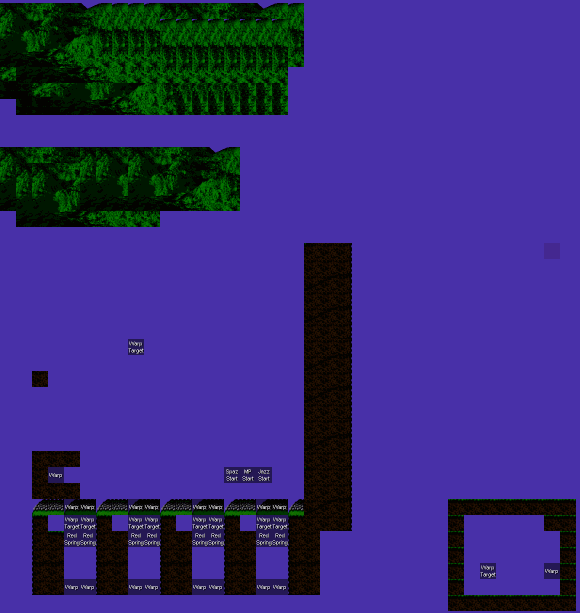
Welcome, one and all, to the race of… uh… 1998, I guess. Gameplay consists of you as Spaz (if you join as Jazz, tough luck) warping into a series of small rooms, and attempting to get stuck in the tile directly above the warp target before you are hit by the ceiling spring in the tile directly below the warp target. You do this four times, then you are taken to a big room where you enter a randomly placed warp, which takes you back to the beginning of the level. There’s not even “Setlap”.
Eyecandy too is abysmal. No tiles really connect together at all, and the only two layers used are 4 and 8. 8 only has tiles in its bottommost row, not the rest, so everything tends to leave trails. One can only wonder why the author bothered to use Townsville ][ Night, if “use” is the operative word.
There’s really no reason to download this. It has no interesting ideas. It’s full of broken stuff and places to fall out of the level. And, believe it not, that screenshot I posted was all of layer 4.
[Adjusted to use 1 as rating. Original rating 0.8. ~Cooba]
- Posted:
- 20 Jun 2005, 08:37
- For: Lost Levels
- Level rating: N/A
Ah, but Race4… Race4 was pretty fun, just needed a few bugs worked out so Spaz wouldn’t have such a major advantage.
n00b: Interesting. And it really wouldn’t be “converted to a Jazz playable format”, as Battery Check and BETA 2 use the same format, right?
Cooba: …yes, it’s possible, but only if you understand the file formats for both .lev and .j2l, okay?
Review by Violet CLM
- Posted:
- 2 Mar 2005, 09:35
- For: Islands in the Sapphire Sea
- Level rating: 8.6
It’s Blade. And he has another tileset. Only this time, it’s different… the name is way too long. Let’s just call it “Islands” from now on. Blade does!
GRAPHIC QUALITY:
Blade retains a very consistant graphic style throughout the set, which is a good thing. The cannons and gold coins are going to look like they were drawn by the same person as the bridges and pirate flags. It’s all generally drawn in the fashion of a generic flash animation, but with a little more detail, and obviously somewhat smaller. Some stuff, like the treasure chest, and the pirate flag, ends up looking really awesome.
Unfortunately, that’s not always true. The cartoony flash animation look has one major side effect, and that side effect is a lack of shading. Textures in Islands are essentially two colors, one light and one dark. Of course, this only works in the case of fixed-size objects, a category the ground does not fit inside of. So the walls are one color with no texture at all. A gray color. And it looks bad. The sand on top of the walls is a lighter gray color, made better by the variety created by various small objects and pathways, but still a textureless fill tool. It generally looks annoying.
To improve the quality of the platforms, there are small pathways added, doubtless inspired by such impressive tilesets as HH98 and Townsville 1. They are the same color as the walls, and do not always manage to look 3D against the textureless sand, but are still a nice touch which more tilesets could use.
I want to clarify that for the most part, the shading does work. On smaller things like the fence posts, you don’t notice the hideous deficiency, and they look great. The barrels look fine with the three shades of brown. The hanging plants are iffy. But the wall sucks, and the sand is annoying, and the caves aren’t too good, and the background makes me want to hide my eyes or at least stand inside of a cave area. Not a very good sign.
Pros: A lot of stuff looks great.
Cons: But on the bigger stuff, the lack of shading strikes back, and is the cause of great ugly. Especially with the background layers.
Rating: 7.2
MASKING:
Masking gets top marks, especially because this is such a complicated tileset. Everything comes in multiple variations when required, and all the slopes are well aligned with their connecting tiles. No jags anywhere. The only downside is the automasked background, which can cause annoyance for those who want to be inventive with the tileset.
Pros: Everything is perfect.
Cons: Automasked background.
Rating: 9.2
COLORS:
Unacceptable. This is the modern age of tilesets, and Blade seems not to have even a rudimentary grasp of tileset palettes. Nothing works. Poles don’t work, snow doesn’t work (it’s brown, which could be imagined as falling sand, but the shading is wrong), pinball doesn’t work, it’s a beach tileset and the water doesn’t work! And there’s no textured background!
Fortunately, the colors actually used by the tiles of the tileset are better. Everything is more or less about the same level of saturation, so your eyes are unlikely to hurt, unless you’re looking at layer 8. There is a definite color scheme – gray is ground, green and blue are background, brown is decoration – which is maintained all through the tileset and limits confusion. The gray is a bit boring, unfortunately.
Pros: Working color scheme, no glaring inconsistencies, stuff works together.
Cons: Boring ground, tileset seems to have used the Remap Tileset Palette button.
Rating: 7.0
VARIETY:
If your favorite subject is variety, this tileset is your dream. There are scads of bits and pieces of eyecandy strewn throughout the tileset. Grass, pathways, barrels, bridges, distant islands, pirate ships, flags, poles, netting, rocks, plants, treasure… I could go on. There is tons of stuff to be found here. The tileset may be slightly less pleasing to those who enjoy making new and different unintended environments, but there are a number of interesting looking things (the netting looks quite promising), so I won’t rule out that possibility. As mentioned in masking, there are variations of tiles to fulfill different purposes, and lots of objects can appear with all sorts of backgrounds. Even the caves, I’m pleased to report, don’t need to be placed in layer 5. But the animations are slightly lacking (the pirate flag is the only one you’ll notice without looking closely), so levels may look somewhat dead.
Pros: Lots and lots of stuff!
Cons: No actual pirate ship to roam around in, but I guess the tileset is pretty big already. Maybe a TSF edition. Only one main type of platform (the sand).
Rating: 8.8
TILE PLACEMENT:
Um. Well. He, uh, tried.
Don’t get me wrong. A lot of the tileset is arranged fairly intuitively. Most of the cool eyecandy tiles to place on the ground are all in the same place, the tileset is recognizably divided into, uh, divisions, and things generally connect well. The background eyecandy area is a little iffy, but it should be possible to piece together.
Unfortunately, all the careful order comes apart where it matters the most, in the formation of the ground. It would take a long time of staring morbidly at the tileset before I’d attempt to piece something together, and it still might be using reference from the example level. Various pieces of wall are thrown together with no connecting tiles nearby, leaving little more than a jumble of tiles which use approximately three colors total (four with transparency). If a few eyecandy tiles could have been sacrificed to make the layout more intuitive, that might have been a good thing.
Pros: Most things are put together well, logical division.
Cons: The wall fails my inspection. Or maybe my inspection fails. I’m not sure which.
Rating: 7.0
OVERALL: I want to like Islands. Its a Blade tileset. It uses ideas I’ve had for a while and puts them to good effect. But something went wrong with the shading, and the tileset needs to be blindly fumbled together, to the point where I don’t think I’d ever use the set. (Before anyone complains, I have used Blade tilesets before. I used Forest. Twice. And Aztec!)
I would indeed suggest that you download it. It’s a great example of what tilesets can be if people put some work into them. It’s a great tileset to LOOK at. It’s the sort of thing you might find in a game. I can’t imagine putting this much effort into a tileset. It just didn’t all work out perfectly in the end, that’s all.
Pros: Very good underlying idea, enormous amount of effort seems to have been spent, uncommon theme, lots of variety in eyecandy, excellent masking, generally a well thought out and produced tileset.
Cons: Not my graphics style, too many unshaded surfaces, complicated theme leads to complicated tileset.
Rating: 8.1
Review by Violet CLM
- Posted:
- 2 Feb 2005, 04:39
- For: Satan`s Ground force pack
- Level rating: 7.9
Ground Force levels are few and far between, especially because custom dictates that they must always come in packs. The main Ground Force pack is, of course, Survivor, which was conincidentally re-rereleased recently. Let’s see how Satan’s pack, which has been rated once before, stacks up against the standards.
The first thing you notice upon running the SGF (Satan’s Ground Force?) pack is that Satan basically copied blur’s level-start system and made it bigger and wider, removing layer 3 and making most parts visible. The room where the host collects blue gems to end the level is now visible, as is everything else. And the rooms are a lot larger. This can look nice, but it loses the “everything fits into one 20×15 screen!!!” effect, so I’m torn. It also uses blur’s anti-jazz system with the bridges, and moves the gold host coin out of the host’s way so it’s easy to not collect it and seriously break the level.
While we’re talking about matters not specific to the individual levels, I’d just like to briefly complain about the text. It’s really bad. There are approximately two text strings in each level – “DO A SIDEKICK WITH SPAZZ” is one of them. It appears six times, and Satan never bothered to look up Spaz’s name. The pack was also bigger, so the levels are described as being Level # of 10, except for #6, which is honest and actually says it’s out of 6. This would have taken, what, a minute to fix? Sloppy presentation.
One small bug – the host can sidekick the crate, and re-enter the passage between host room and main waiting room, thus not entering the arena at the appointed time.
Magical jungle
The first level is in charge of the first impression, and Magical jungle handles that nicely, offering some nice eyecandy at the start, which is something blur could occasionally be lax in. It’s all standard Jungle use, but it looks good.
Unfortunately, the arena itself is not so appealing to the eye. There’s a fairly sparse background, with some tall things (trees and the like), and then it attempts to get more eyecandied down at the bottom. But it messes up. Most of the little background details are ok, although the strict adherence to speeds 1/1 is a little annoying. The tree would be fine too, except it sprouts from the ground. A big ground. An enormous floating ordinary looking Jungle style platform – which is COMPLETELY UNSOLID. So annoying!
Anyway, the rest of the graphics are fairly boring, as the author chose to use the standard destruct blocks. The ones which look good in a small clumb but not when they’re composing the entire screen. As a result, Magical jungle ends up looking ugly as soon as you enter, and the effect only lessens once a lot of the blocks are destroyed.
The blocks are destroyed quite quickly, though. Magical jungle has a very strict setup – enormous amounts of TNT crates are placed in chains through the level, meaning that only a few pre-chosen parts of the level will remain when everything has blown up. Once that’s all taken care of, hit the remaining crates and what’s left of the level will be destroyed, leaving everyone to claim winnership depending on how long it took them to fall in or unfreeze. (Yeah, the freeze enemies are back too. This really feels like a copy of Survivor.) Technically a few platforms are left over, but I don’t like them.
So, I’m not too thrilled with Magical jungle. It’s kind of ugly and way too prescripted. The chain is an interesting idea, though, and it has a few sparks of fun, so I’ll not go too harshly on it.
BOOM base
BOOM base is much better than its predecessor, but it seems I’ve written a lot already so I may not have as much to say. Possibly breaking the author’s claim that the pack only uses standard sets, BOOM base uses a Mez tileset, you know, the brown one that got used by Shadow. It’s used well. There are ladders, tubes, glowing holes, lots of interesting looking stuff. The walls of the level are green and gray blocks – not as interesting looking as blur’s level of the same tileset, but a whole lot better than Magical jungle.
The design isn’t too remarkable and is actually somewhat boring, but I like the idea behind the level. Once you hit a bunch of crates (as usual), the true level design is revealed, which appears to be a bunch of tiny platforms above a long line of Collapse Scenery blocks. It’s actually kind of fun, and there’s lots of hourglasses floating around.
So, BOOM base ends up being interesting, but the majority of the level is useless and uninteresting and way too flat. Decent eyecandy, decent idea, not the best execution but fun anyway.
Electric Shock
Electric Shock feels more like one of blur’s levels, specifically his first. There’s a random level, you go to the top, hit a crate, and most of the level is destroyed. blur used lasers, Satan uses DNA strings composed of TNT crates. Whatever. In any case, I guess it’s an ok idea. Not so ok is the level design itself, which relies heavily on players somehow being able to run up 32 pixel slopes – I.E. solid blocks. It’s like Polar Chill or something, but without the slopes.
Another strange aspect of Electric Shock are the RF crates – which appear in such abundance that the level would make more sense if it was called BOOM base. If you shoot the crates, they’ll explode and not do much. Take the ground out from under, they’ll fall down and maybe (but maybe not) destroy the block they land on. They’re essentially useless, just like in Overlord’s RHG level. Interesting, but I’d like to see an actual use for the little things.
Eyecandy in the level is about what you’d aspect. For the most part, Satan uses Tubelectric quite well. The only exception is, again, the arena itself, which is mainly composed out of ordinary destruct blocks, which take up far too much of the screen. Ouch. Electric Shock gets kudos for including two blue gems instead of one.
HOT ground
Ok, first, no. This isn’t hot ground. All the blocks are blue destruct blocks (…arrgh!!!). The background is reddish, but certainly not hot looking, just kind of mournful. The only part that even suggests hot is the fire at the bottom, and I wouldn’t quite count that as ground. HOT ground is an extremely misleading name for a level which mostly feels like it’s supposed to be frozen over.
Anyway, the eyecandy is, as usual, very good but disappointly standard. As is often the case with the level design, Satan takes no chances, instead going completely by the book of CliffyB. Everything is what it’s supposed to be used for, although the bones are in the background and that’s not normal and actually looks kind of cool.
As for the level design, there kind of isn’t any. At the bottom of the level is a long horizontal plane of ordinary destruct blocks (again argh) with a crate on it. Hit the crate and a few TNT crates fall here and there on the rest of the level – or the lack of such. You see, other than the thing at the bottom, Satan just went wild with the “press tile” tool and placed destruct blocks randomly all over the arena. Then some random ammo, and voila, the level was done. Blah. Uninteresting.
Hurting Grounds
Hurting Grounds has a good concept – make the blocks look interesting, add slopes, have floor tiles be destroyed if you stand on top of them and shoot. Execution is somewhat flaky, as the level design ends up being again way too flat, and the level is practically destroyed when you hit the crate. There are turtle shells and stuff, but who cares? It all gets destroyed almost instantly.
Eyecandy’s good and nothing to say about. But the third frame for the destruct scenery blocks is badly chosen.
Old Grounds
As I mentioned earlier, Old Grounds is notable for being the only level to notice that the pack is six levels long. It’s also notable for having a really weird level design.
In most Ground Force levels, you have to try to stay in. In Old Grounds, you have to work to fall out. It’s divided into three floors of basic destruct blocks (kill), one on top of the other, and you can only get to the next floor by finding and hitting a crate. How long it’ll take before someone is bored enough to hit the crate is sort of going to depend. Anyway, the floors have a huge number of blocks in them, and most of the level probably doesn’t get destroyed.
The final floor has an interesting bottom. It has a row of Switch Blocks, ready to be destroyed when you hit the final crate. Above that are several little platforms made out of Butt-stomp blocks. These come in handy when the switch blocks are gone, as they can only be destroyed by TNT, or some rascal going around and sidekicking the platforms before the crate is hit. It’s pretty fun and requires some interesting thinking.
So, cut out the top two floors, and I’d enjoy Old Grounds a little more. It’s got decent eyecandy, not the best at all, but not bad, and the thing with the knights at the start is fun (if somewhat ignorant of physics). Bla, bla, bla, I’m done with this review.
Review by Violet CLM
- Posted:
- 8 Jan 2005, 00:44
- For: What is this?!
- Level rating: 8.8
DESIGN/GAMEPLAY:
What is this?!‘s level design is (for the most part) built out of tunnels through walls instead of platforms in the sky, a choice which I approve of immensely and vastly prefer. The level appears to be divided into several parts – outside, temple and cave, all placed logically – and each location has a design which is roughly believable, if man or nature ever built the world to be used as a battling arena. The level is somewhat horizontally based in places, suggesting that it indeed was once intended to be a CTF level, but this is not a bad thing at all and it’s always nice to have a passageway which is more than five tiles wide. (Platform based levels are often guilty of never having passageways, unless forced to by moving up against the top or bottom of the level.)
In any case, the level design is somewhat complicated, so it takes a while to figure out which places can go to which others, and which way sucker tubes point. (You wouldn’t expect sucker tubes to work in this environment, but somehow they feel like yes, they should be there.) After some minutes of playing the level you should get an idea of what’s going on, but it can take a little while, partly due to the intense graphics which I’ll mention later.
Once you’re used to the level, of course, the fun really begins. The weapons are well chosen – each of the available powerups (Seekers, RF’s and Bouncers) have special areas of the level where they’re the most useful, even the RF’s which are usually left out in the cold and random. There is enough open space in the upper right and long space in the middle that the missiles can have a decent change of actually hitting someone for a change in situations besides melee battles where other attacks would work just as well. Coupled with the occasional wall put up between areas, causing you to take a specific set of passages, the end result is a very nice feeling level where you may actually have to think about what you’re doing.
(NOTE: Gameplay for this level has only been tested in a 2-4 player type scenario. Balance may vary significantly with more players as certain spots may or may not become focal (perhaps the powerups). Still, I liked what I did see.)
PROS: Inventive mix of Battle/CTF layouts, I particularly enjoy the upper left area.
CONS: Small masking bug at one point, I don’t really like the upper right area very much (and it was mostly untouched in gameplay).
RATING: 8.7
EYECANDY:
Before you can get used to the twisty level design, you will be struck by the enormous level of eyecandy What is this?! has to offer. Every layer is crammed full of beautiful sights – five distinct layers are used with X and Y speeds set to 1, and in a great number of cases they’re all used in one spot! Everywhere you go there are twists, trees, different backgrounds, complicated walls, bushes, blocks, caves, vines and a thousand other decorations. Layer 3 in JCS looks great even if you have no idea what it’s going to do.
Many levels with lots and lots of eyecandy fall into the trap of obscuring the level design (see: virtually any level made using “Swamps of the Sleeping Jaguar”), and this happens a little in certain spots, but for the most part you can still see the level beneath the finery. I do have a few complaints – it’s hard to tell what’s a vine and what isn’t – but most stuff seems logical and you could spend a long time looking at the trees.
PROS: Everything looks great, you can tell a lot of work was spent on this level.
CONS: A tiny bit overcomplicated in some areas, and some people might complain that nothing moves. (Moths work in multiplayer, right?)
RATING: 9.1
PLACEMENT:
This is always somewhat hard to review, as it’s difficult to tell what’ll be enough ammo with more players than I tested it with. In any case, there is quite a lot of ammo in the level, all easy enough to get, and in some interesting formations (again, see the upper left corner). Everything seemed to respawn at about the right speed (maybe a little bit fast? hard to tell), and I don’t think I ever really ran out of anything. There were a few complaints which I’ll outline in cons, but nothing too serious.
As for other stuff… there are two carrots that I remember seeing, both pretty well placed. I quite enjoyed the bottom right one, which just felt… right. It felt like yes, that is exactly where a carrot should be. The other carrot is also good, allowing for much strategic shooting as you prevent your opponents from healing up. Finally, there are the normal three powerups (no toaster, which makes sense as toaster isn’t too useful in this level somehow).
PROS: Everything looks good to me.
CONS: Seeker powerup is the easiest to get, one or two annoying springs, and of course… there’s only one start position. Ouch.
RATING: 8.4
OVERALL:
In case the rest of this review didn’t give you the idea, I quite enjoy Newspaz’s What is this?!, and can only suggest that the rest of you download it as well. It’s still extremely early, but I wouldn’t be surprised if this was one of the best levels of 2005, even though it could use a more start positions. The filename is j2lcdunno1, indicating that there might be a sequel… yes, please.
PROS: It’s a great level, ok?
CONS: A few small bugs I mentioned during the review.
RATING: 9.0
- Posted:
- 11 Dec 2004, 21:26
- For: FSP: Rent Collection
- Level rating: 9.1
Another alternative for the .bat files is using the “Captain Cook” program, or just running JJ2 with a command line.
- Posted:
- 29 Nov 2004, 09:41
- For: Energia of Tubelectricity
- Level rating: 5.8
why is it ALWAYS TUBELECTRIC?????????????/
- Posted:
- 9 Nov 2004, 00:36
- For: Easier to read JCS.ini
- Level rating: N/A
In this pack, Nobody attempts to offer a simple JCS.ini version for users who are unexperienced with JCS, in addition to a complete version with everything left in, including broken stuff. The complete version seems good enough, but the basic file (named JCS.ini to confuse people) has a few problems.
The main problem is that it leaves in a lot of broken events and parameters, like Dim Light. It also removes events that do actually do something, like Fast Feet. The removal job is often quite poor, leaving scraps of information in the .ini file, and Area ID is only half renamed to Rocket Turtle Path (the thumbnail name being “Path ID”). TSF users are also out of luck, as the basic file included here does not include any of the TSF events. The full featured file does have them, but isn’t the whole point of this upload allowing people to use a more basic .ini file?
Documentation is also somewhat poor. The readme, which manages to spell “beginners” wrong, refers to the contents of the .zip as the following:
JCS.ini (described as backup, actually the main file)
JCS-1.23.ini (described as main file, doesn’t actually exist)
JCS-FULL.ini
JCS-TSF.ini (described as basic event list for TSF – unfortunately, it’s not included)
Considering this is for unadvanced users, you would hope that the instructions would be well done, but even here the author fails, instructing you to perform the same task multiple times, and generally confusing me as well as countless new people. I reproduce the conflicting orders here:
Extract one of them to your Jazz 2 folder.
Delete the old JCS.ini
Extract one of the files to the Jazz 2 Folder:
(list of files)
Rename that file you extracted to JCS.ini
All in all, a good try, but it doesn’t quite manage to live up to expectations. The basic file leaves too much in and is poorly cropped, the main file is poorly edited, and I’m not even sure why there’s a backup file in there. Not even a trigger zone!
Review by Violet CLM
- Posted:
- 9 Nov 2004, 00:02
- For: FearofDark JJ1 (Episode 3: The Smell of Fear)
- Level rating: 6.3
This episode was something of a disappointment. Gone are the interesting ideas from the previous episodes, instead there are only four single player levels and a boss, mostly without interest. Now that the sparkle is gone, the levels must stand on their own, and they are revealed to be short, and often uninspired. The eyecandy varies between levels – Technoir looks good, while Medivo is positively ugly. There are no “next level” bugs this time, but that doesn’t make up for the fact that yes, this installment feels heavily rushed.
So, these are ordinary single player levels, but what kind? The “shoot shoot shoot” kind. Jazz runs through a series of passages generally unloading his blaster at each new villain, few of which are placed in very interesting locations. There were a few well done areas, but for the most part these were quite generic and without interest. Perhaps next time the fun will be back, and maybe the author can even introduce a plot??? who knows.
Download recommendation: Mostly a yes, but if you liked the last two installments a lot, you may not want to download this one, where the bonus level is not even remotely enjoyable.
Review by Violet CLM
- Posted:
- 8 Nov 2004, 23:44
- For: Fearofdark Jazz 1 (Episode 2: 23,000 miles away)
- Level rating: 7.7
23,000 miles away is one of those rare sequels that seems to be better than the original, encompassing all the best features of the previous episode – decent levels, lots of secrets, inventive ideas and no storyline at all – and adding them into new tilesets and new levels. I was a bit worried by Tubelectric, which was short and uninteresting, but the levels got bigger and better from there on out. The levels in this pack are still probably a little shorter than your average single player level, but there are several, and they all play well. Significantly fewer bugs than last time, and better eyecandy as well, though there were still some dull aspects.
This is just good in general, so it’s hard to find complaints, but I do have three. The levels are a little too short, some of the secrets (containing major stuff like powerups and shields) are a bit too easy to find, and there’s a general lack of story. I saw no real reason to be playing these levels otehr than the author having fun with different tilesets. Oh well. The levels could also use some more food and gems.
EDIT: Oh! The wrong Candion conversion was included in the .zip. Bad. Rating decreased to 7.9.
Review by Violet CLM
- Posted:
- 8 Nov 2004, 23:17
- For: Fearofdark: Jazz 1 game. (Episode 1: Devans Comeback
- Level rating: 7
Huh. What we have here is a very nice single player pack, and it’s only part one. The levels all have their own individual style, and feel more or less like they belong in that tileset. Lagunicus has a lot of caves, Dreempipes is more trigger based, Diamondus is simple and flattish, etc. However, none of the levels are really all that remarkable, and there’s no apparent story, so this is not too much more than a collection of decent single player levels, all using JJ1 tilesets.
What the author lacks in level design ingenuity, he tries to make up for in flashy special effects. Strange sucker tube arrangements, fun secrets, dropping bombs, and even bonus levels add to the replay value of this pack, which alternates between normal gameplay and interesting diversions.
Unfortunately, the levels are not perfect. The eyecandy is not bad, but a lot more could have been done with the tilesets, causing some parts of the levels to look rather bland. There were also a number of tile bugs that I spotted – for examples, the slopes aren’t masked correctly in Lagunicus, and everything looks wrong underwater in Dreempipes. The last level incorrectly links to JJ16.j2l, instead of the boss level included. So there are a few problems.
Still, this is fun enough to play at least once, and how many good single player levels have you seen uploaded lately? This should help the wait for TDI2, or TR2, or FSP, or whatever sequel you happen to be waiting for.
Review by Violet CLM
- Posted:
- 8 Nov 2004, 21:15
- For: The Deadly Light
- Level rating: 3.4
Interesting, but blinding. “The Deadly Light” undoubtedly refers to the background, which looks almost pure white, and is very rarely obscured. The level has so much open space that you are always forced to stare into the pain that is layer 8. Bad move.
So, the level has a lot of open space. This is because it’s composed of a lot of squarish platforms placed so they’re reachable, but not easily. This is not all the author’s fault, as slopes in this tileset are kind of missing, but it’s still annoying. If you climb up all the tiny platforms and make your way through the obstacles, you reach a 100 coin warp which can take you to a room filled with ammo of all sorts. However, why would you want to? The ammo respawning speed is so incredibly fast, so you should have an ample supply of that, and all the good stuff is at the bottom anyway. At the bottom right of the level lies four carrots, an RF powerup, some seekr ammo, and an unguarded Plasma shield. Simply put, there is nothing else in the level worthy of looking at compared to this tiny spot. Why should anyone leave it? What’s the point of the rest of the level?
Eyecandy is pretty dismal. The bottom of the level actually doesn’t look that bad, with wooden platforms coming out of the water, but the rest of layer 4 is minimal, layer 8 is blinding, and there’s no background eyecandy at all. The author did try in some spaces, and that’s good, but it often didn’t work out.
The level is also extremely buggy. First, there’s the awful lack of balance I mentioned earlier where everything of value is in the bottom right corner. Second, there’s the open level borders, with springs and stuff right next to them. Third, there is both a gem ring and lots and lots of freeze ammo. The first person to not like this level will shoot the gem ring, and the server will crash. Not a good combination. Last, the thing showing the position of the coin warp is actually a bonus warp, which will try to take you to the secret level if you shoot it. Was this level tested at all? I can only suggest that you don’t download it.
Review by Violet CLM
- Posted:
- 8 Nov 2004, 20:55
- For: Mystic Island
- Level rating: 8.6
Late review time. “Mystic Isle” by Moonblaze is an average tileset which attempts to look classic game style, but doesn’t really make it happen. Let’s take a look.
GRAPHIC QUALITY: Moonblaze uses an 8-bit drawing style, which I approve of, but which only works so well in cases like this. Some things look good – the vines and gems especially – but the main part of the tileset, the ground itself, suffers a little. Simply put, the ground is ugly. The grass isn’t too bad, though kind of dull, but the soil is a single shade of unknown-color, and that doesn’t work. It kind of looks like a resized version of Swamps, but not as good. I really wanted to see some sort of soil texture here, as a single color rarely works. Ironically, the next level setting lead to Colonius, which uses the technique much better.
Meanwhile, as I said, a lot of things look good. All the brown vine stuff is very nice to look at, and if the rest of the tileset looked like that, it would be great. The green wood, though, poles and sucker tubes, ends up looking like a simple gradient with no variety, and it’s all flat surfaces. Not too appealing to look at. Rocks are a mixed bag, and the wooden platforms look pretty good, though again a little too small.
Pros: Very nice vine stuff, wooden platforms not too bad, gems are cool.
Cons: Soil is pretty ugly, too many straight lined gradients.
Rating: 6.6
MASKING: High marks here. Everything is masked perfectly, and the author even was nice enough to create some cool rock-leaning-against-wall structures which the player can walk up and down upon. There are really only two masking parts I’m not thrilled with. The giant glowing white gem tiles are automasked, which could cause stucking troubles in some levels, and the big mask message messes up a lot of the background eyecandy tiles which could otherwise be used for fun stuff. I’m also concerned that the wooden platform tiles may be masked a little thin, but that’s not a big issue.
Pros: Mostly good, the leaning rock stuff is fun.
Cons: A few automask issues, and the wooden platforms may be too thin.
Rating: 7.8
ORIGINALITY/VARIETY: There is very little to set this tileset apart from any other nature tileset, and especially from others that Moonblaze has made. The gem stuff is kind of cool, but there’s little reason other than that to use this, as almost everything in Mystic Isle is available in Swamps, only bigger and better. Isle is designed for a certain level (or set of levels… whatever) in TDI2, but other than that, it’s not too interesting.
As for variety… well, the tileset does offer a number of things. Basic ground, tiny wooden platforms, cave eyecandy (with no tile support at ALL – you have to use layer 5), event tiles, and fun gem stuff. I am, however, missing slopes. The basic ground has no slopes, unless you count the tilted rocks, which would become really old after seeing even two of them in a row. Levels made with this tileset will feel squared off, which is really pretty annoying.
Pros: Decent environment, lots of cool eyecandy things, well-made background eyecandy, etc.
Cons: Bad slope situation, and little that is new or different.
Rating: 7.5
TILE PLACEMENT: Pretty much everything in the tileset is placed logically, though there are a few random eyecandy tiles which should probably be placed closer to their base. Having the hook inserted horizontally is also kind of weird.
Rating: 8.0
OVERALL: This is not a bad tileset, but it’s hideously overrated, and kind of boring. If you want to have fun with single player and weird triggers and in-depth storylines, this tileset might be good, but for most levels there are better options out there. Still, it’s well put together and has a lot of features. A mixed bag.
Pros: Cool stuff, not badly drawn for the most part, especially as it was done in Paint.
Cons: No normal slopes, some tiles look kind of ugly, particularly the soil itself.
Rating: 7.2
(Edit: Hi, Moonblaze. If you check my review you’ll see that I noticed your tilted rocks, and said that they would look really boring if you had several in a row. I’ll admit that I didn’t mention the bridge things, but you’ll also notice that I said “the BASIC GROUND”, not “NO SLOPES AT ALL”.)